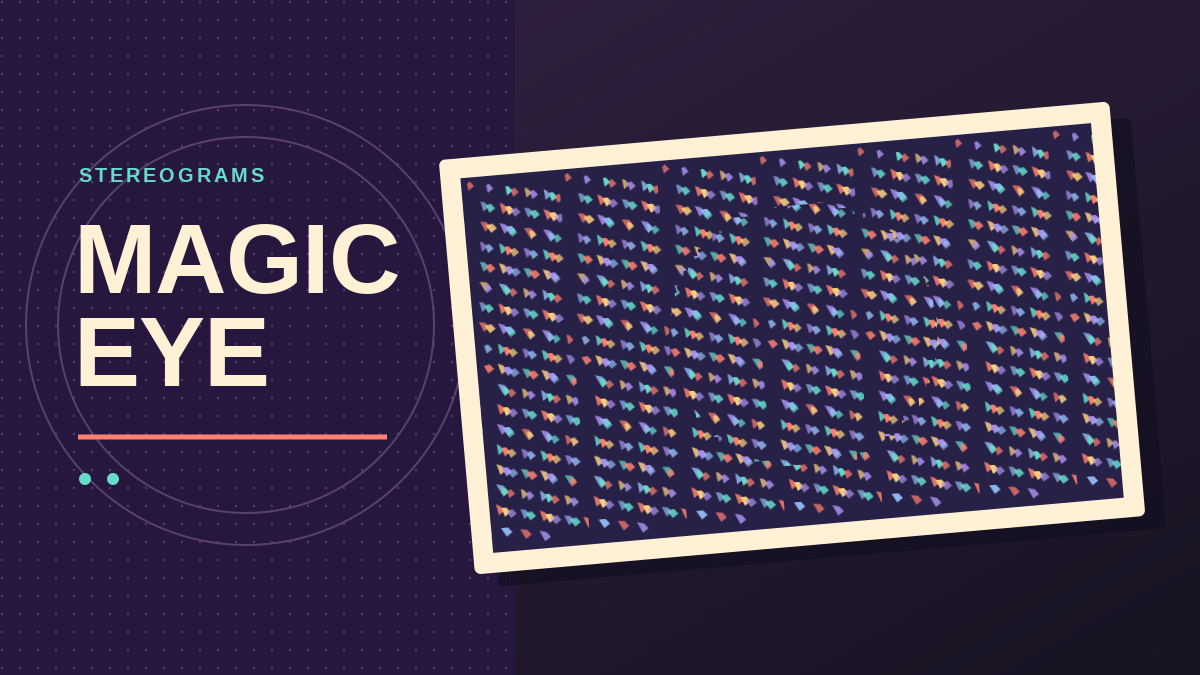
“It’s a dolphin.”
This was a bold claim about a rectangle that appeared to contain forty thousand pieces of confetti and absolutely no marine life.
Someone else saw it immediately. Someone else saw two dolphins. You were beginning to suspect an organized dolphin conspiracy.
Magic Eye pictures turned looking at a page into a public performance. Suddenly there was a right way to use your eyes, and the person beside you was coaching as if you were parallel parking a submarine.
Stare harder, but somehow less
The advice sounded suspiciously like a riddle: look through it. Relax. Stop trying so hard. Try a little harder.
If the depth effect finally appeared, it could feel less like spotting a hidden object and more like the paper had acquired a secret basement. The pattern remained, but now part of it seemed to float in front of or behind another part.
If it didn’t appear, the same page remained an unusually aggressive carpet sample. Both experiences could happen in the same room. Being the last person to see it was no fun, especially when the first person had become the regional dolphin consultant.
Your brain does the assembly
Science World’s stereogram explanation begins with ordinary depth perception. Your eyes occupy different positions and receive slightly different views. Your brain uses those differences as one source of depth information.
A single-image stereogram exploits that process with a carefully repeating pattern. When the eyes align corresponding parts of the pattern in a particular way, the brain can interpret the differences as depth. The flat picture hasn’t physically changed; the interpretation has.
That is why these images are more than a tiny drawing hidden among bigger drawings. Finding an outline by searching each square inch misses the trick. The interesting part is how the two eyes’ views get matched.
PAGE:     pattern pattern pattern
             \          /
              LEFT    RIGHT
                  \  /
                  BRAIN
                    |
          "Apparently: dolphin."
Not everyone finds these pictures easy or comfortable to view. Seeing the effect is no intelligence test, and turning it into an endurance contest improves exactly nothing.
The picture that wouldn’t explain itself
Modern 3D displays also play with differences between the views presented to your eyes, though the display methods vary. Magic Eye’s particular charm was putting the whole negotiation on a motionless printed page.
No batteries. No headset. No loading bar to blame. Just you, a pattern, and the possibility that your own vision had overlooked a dolphin.
The moment the image resolved could feel like joining a tiny secret society. The initiation required no password, only an awkward expression and several minutes of someone saying, “No, farther away.”
And the society’s first order of business was obvious: find somebody who couldn’t see the dolphin yet.