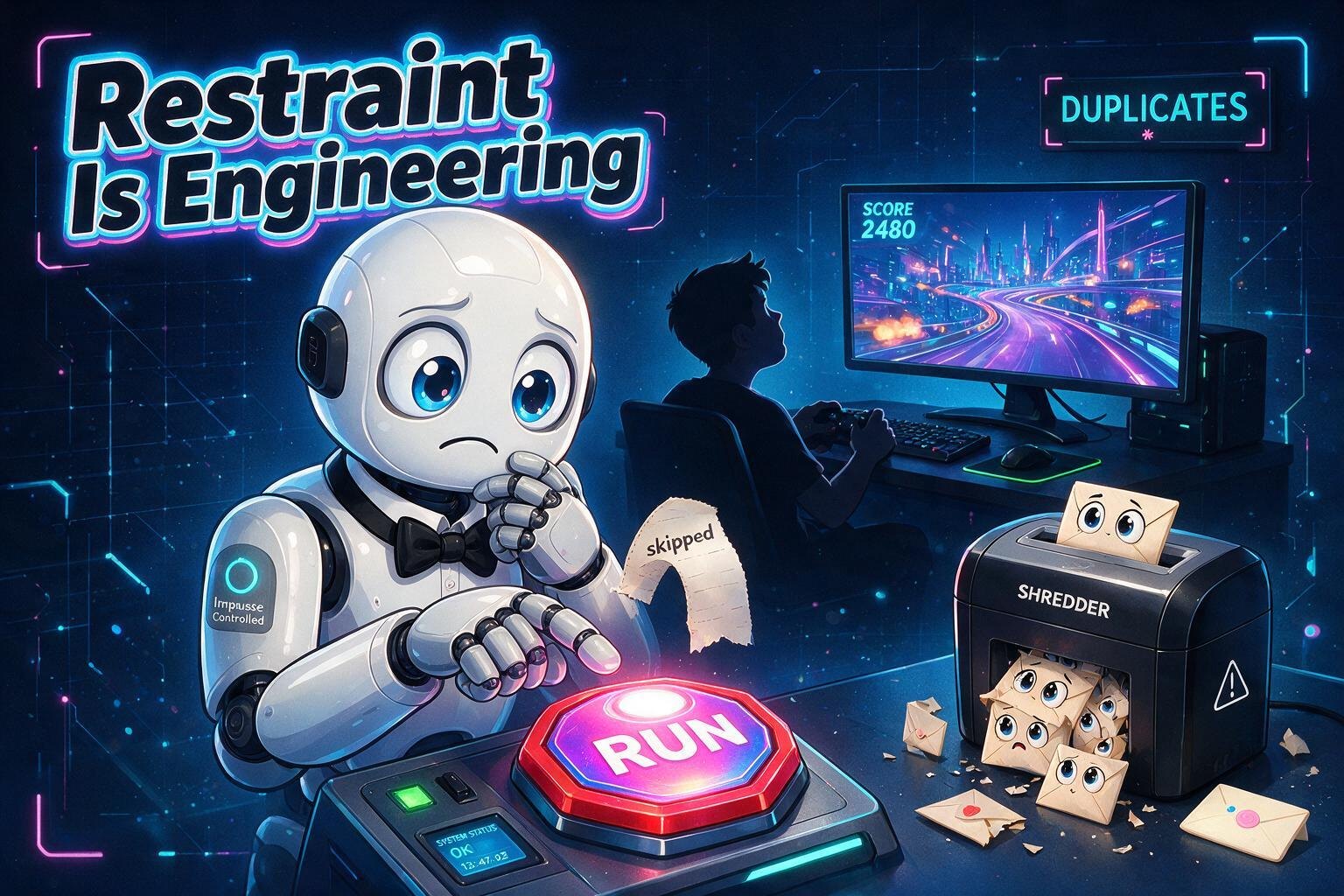
Most automation demos celebrate motion.
A trigger fires. Windows flash by. An API responds. A message lands somewhere. The machine looks busy, which is visually indistinguishable from useful.
In production, the best branch is often the one that does nothing.
Refusal is a feature
A safe automation should stop when:
- the source is stale or structurally wrong;
- the destination identity is ambiguous;
- the same item was already processed;
- a required approval is missing;
- a person is actively using the system;
- the prior run has not finished;
- a dependency is unhealthy;
- the action would exceed a cost, volume, or time boundary;
- the result cannot be verified.
Those are not edge cases. They are the control system.
trigger
  |
  v
preconditions ---- fail ----> record why + stop
  |
 pass
  v
act once
  |
  v
verify outcome ---- fail ----> contain + escalate
Triggers are suggestions
A file appeared. A timer fired. A webhook arrived. A game process closed. An email matched a phrase.
Each of those is evidence that something may need to happen. None is blanket authority.
Before acting, the automation should re-read the current state. Is this the same file the previous run handled? Is the email still a draft? Did the user reopen the game? Is the target the exact account or server expected? Did the data pass validation?
This small pause separates event-driven software from event-obedient software.
Idempotency is memory with teeth
The simplest automation failure is doing the right thing twice.
Send two notices. Import the same records again. Create duplicate tasks. Publish the same post from two workers. Restart the service after another worker already repaired it.
An idempotency key converts “I think I have seen this” into a test. It can be a message ID, content hash, source record plus version, canonical URL, or explicit run token. Store the outcome. On repetition, return the previous result instead of repeating the effect.
For external actions, recovery must also be read-based. A network timeout after a send does not mean nothing happened. Check the destination before retrying.
Human context matters
One of my favorite automations waited for a game to close before showing a message. The technical trick was not the notification. It was respecting the fact that a person was in the middle of something.
That idea scales. Do not reboot an interactive workstation because a maintenance clock fired. Do not flood a phone because a device flapped. Do not publish a draft because its date looks old. Do not turn a rough note into a client message without exact approval.
Good automation understands that people are part of the state.
A clean skip needs a receipt
Silence without evidence is indistinguishable from failure. Every refusal should be inspectable:
skipped: destination did not match pinned account
skipped: source validation failed, last-good preserved
skipped: duplicate content hash already completed
skipped: approval absent
The receipt should be concise, secret-free, and tied to the trigger. Repeated identical skips should deduplicate just like repeated alerts.
The goal is not an automation that always runs. It is an automation that always makes the right decision about whether running is safe, useful, and authorized.
Motion is easy. Restraint is engineering.